

Baseball Equipment Market Set to Reach USD 34.90 Billion by 2035 as Youth Participation and Protective Gear Demand Rise
Baseball Equipment Market
The Baseball Equipment Market is expanding with rising participation, youth programs, demand for innovative bats, gloves, protective gear, balls, accessories.
Innovation, youth participation, and advanced equipment are shaping the next phase of the baseball equipment industry.”
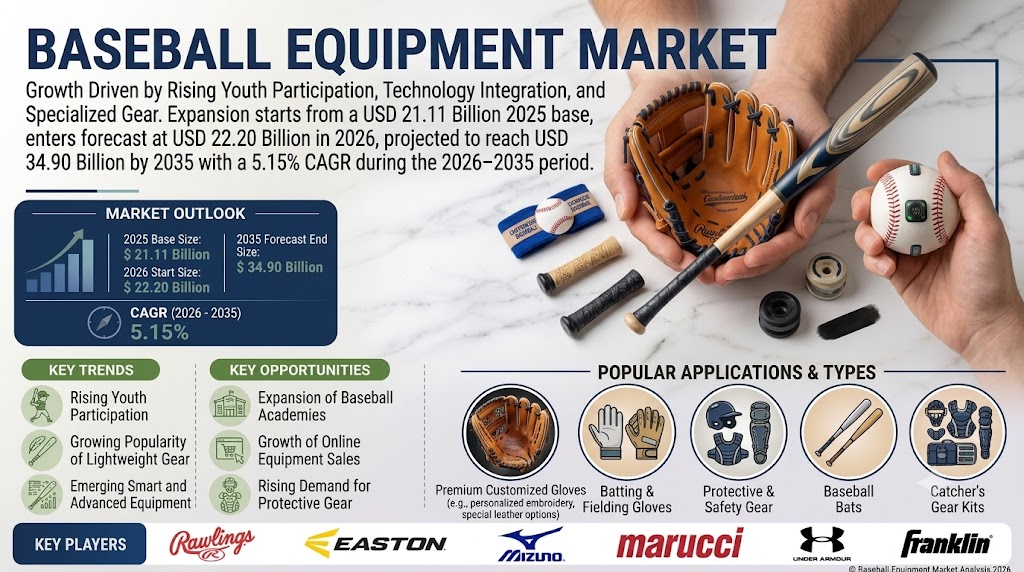
NEW YORK, NY, UNITED STATES, August 31, 2026 /EINPresswire.com/ -- The global Baseball Equipment Market is entering a period of sustained expansion as baseball participation, youth sports programs, recreational leagues, and demand for performance-focused sporting goods continue to strengthen. The market, encompassing bats, balls, gloves, protective equipment, and related accessories, is projected to increase from USD 21.11 billion in 2025 to USD 34.90 billion by 2035, representing a 5.15% CAGR between 2026 and 2035. The industry is being shaped by changing consumer expectations, product innovation, improved access to organized sports, and greater attention to player safety.— Market Research Future (MRFR)
Baseball equipment has evolved beyond traditional sporting goods as players increasingly look for products that combine performance, comfort, durability, customization, and protection. Manufacturers are responding with improved materials, specialized product designs, ergonomic features, and equipment suited to different age groups and playing levels. At the same time, the expansion of online sporting-goods retail is making specialized baseball products more accessible to consumers in established and emerging baseball markets.
Baseball Equipment Market Enters a New Phase of Expansion:
The baseball equipment industry represents a broad ecosystem serving professional athletes, amateur players, children, school teams, community leagues, and recreational participants. Demand spans fundamental products such as baseball bats, balls, gloves, and catcher equipment as well as helmets, protective padding, bags, training aids, and other accessories.
The projected increase in market valuation reflects a combination of rising participation and product replacement cycles. Baseball equipment experiences regular wear through training and competition, encouraging consumers and organizations to purchase replacements or upgrade to newer models. Young players may also require new equipment as they progress through different age categories, creating recurring demand throughout their sporting journey.
Another important factor is the increasing emphasis on product specialization. Players now have access to equipment designed around particular positions, skill levels, playing styles, and physical requirements. This shift allows manufacturers to address more precise consumer needs while encouraging buyers to consider performance characteristics rather than simply selecting standard equipment.
The market's long-term trajectory is also supported by the growing integration of baseball into structured youth sports programs. Schools, academies, community organizations, and private training centers are introducing more children to organized baseball, creating demand for age-appropriate equipment and safety products.
Recent News & Developments:
▪️Rawlings (March 2025): Introduced the REV1X 2.0 glove series with adaptive-fit technology and a lighter design for advanced players.
▪️Wilson Sporting Goods (January 2025): Acquired Victus Sports to strengthen its bat portfolio across wood, alloy, and composite categories.
▪️Easton Diamond Sports (September 2024): Launched the Ghost Unlimited fastpitch bat series with advanced composite technology and enhanced performance.
▪️Marucci Sports (June 2024): Entered a multi-year partnership with USA Baseball as the official bat supplier through 2028.
▪️MLB International (April 2024): Expanded the Play Ball initiative into 14 additional countries to encourage grassroots baseball participation.
▪️WBSC (November 2023): Announced the expansion of the Baseball5 World Cup to 32 teams, supporting participation in emerging markets.
▪️Dick’s Sporting Goods (August 2023): Reported increased baseball category sales, supported by rising youth participation and demand for premium bats.
Rising Youth Participation Creates New Commercial Opportunities:
Children represent one of the most promising areas of expansion in the global baseball equipment industry. The children end-user segment is projected to record a 5.47% CAGR, making it one of the fastest-growing areas during the forecast period.
Youth participation is important because equipment requirements change substantially as players grow. Children require lighter bats, properly sized gloves, protective helmets, appropriately fitted apparel, and equipment designed for their level of strength and coordination. As participation continues, families frequently replace equipment to accommodate physical development and changes in playing level.
The expansion of youth baseball programs can also introduce new customers to established sporting brands at an early stage. Manufacturers that build products around comfort, safety, ease of use, and attractive designs can develop long-term relationships with young athletes and their families.
Parents are becoming increasingly attentive to the safety and suitability of sports equipment. This is particularly relevant for younger players, where improperly fitted or unsuitable equipment can affect comfort and confidence. Consequently, brands have an opportunity to differentiate themselves by providing clear sizing systems, youth-oriented designs, durable construction, and products that balance protection with mobility.
Digital platforms are further supporting this segment by giving parents access to a wider range of products and reviews. Online product descriptions, sizing information, demonstrations, and educational content can make it easier for families to select appropriate equipment.
These companies compete through product innovation, brand recognition, athlete relationships, distribution strength, product specialization, and marketing. Their ability to respond quickly to changing player preferences will remain important as consumers increasingly compare products based on detailed performance attributes.
Rawlings has a strong association with baseball equipment and serves multiple categories across player levels. Wilson maintains a broad sporting-goods presence and offers baseball products designed for various playing requirements. Easton has developed a strong position around baseball and softball equipment, particularly in categories associated with bats and related products.
Mizuno brings extensive experience in performance sports equipment and has established a recognized presence among baseball players. Marucci has built its identity around baseball-focused products, while Victus is particularly associated with specialized bat offerings.
Under Armour, Franklin, Schutt, and SSK contribute to different areas of the broader equipment ecosystem, including apparel-related products, accessories, protective equipment, and baseball-specific gear. The combination of broad sports brands and specialist manufacturers creates a competitive environment in which product differentiation remains essential.
Get Full PDF Sample Copy of Report: (Including Full TOC, List of Tables & Figures, Chart) @
https://www.marketresearchfuture.com/sample_request/28566
Competitive Landscape Remains Innovation Driven:
The global Baseball Equipment Market includes established sports brands and specialized baseball manufacturers competing across equipment categories, price points, distribution channels, and geographic markets. Key companies identified in the market landscape include
▪️Rawlings
▪️Wilson
▪️Easton
▪️Mizuno
▪️Marucci
▪️Under Armour
▪️Franklin
▪️Schutt
▪️Victus
▪️and SSK.
Product Innovation Reshapes Player Expectations:
Technological development is changing the way baseball equipment is designed and marketed. Consumers increasingly expect equipment to provide measurable improvements in handling, comfort, control, durability, and consistency.
Bat manufacturers, for example, can differentiate products through material composition, weight distribution, barrel construction, grip design, and balance characteristics. Glove manufacturers can focus on fit, flexibility, pocket formation, materials, and position-specific designs. Protective equipment developers can emphasize impact management, ventilation, weight reduction, and adjustability.
Customization is another important opportunity. Players often have individual preferences concerning equipment dimensions, colors, materials, branding, and performance characteristics. Digital purchasing platforms and modern manufacturing capabilities are making personalized products more accessible.
Training products are also becoming increasingly relevant. Players can use specialized accessories to practice batting, throwing, catching, reaction time, and coordination outside formal games. This creates an opportunity for manufacturers to expand beyond traditional equipment and build broader product ecosystems around athlete development.
The combination of product innovation and digital marketing is likely to influence purchasing behavior throughout the forecast period. Consumers can compare products, watch demonstrations, examine specifications, and access recommendations before making a purchase. Brands that communicate product benefits clearly and demonstrate practical value can strengthen their position in an increasingly competitive environment.
E-Commerce Expands Access to Baseball Equipment:
The growth of digital commerce is changing how consumers discover and purchase baseball equipment. Online platforms provide access to extensive product ranges, allowing customers to compare different brands, models, specifications, and prices from one location.
This is particularly useful for consumers who live outside major baseball centers or lack access to specialized sporting-goods stores. E-commerce can broaden geographic reach and help manufacturers serve niche requirements that may not be economically practical for conventional physical retailers to stock extensively.
For youth equipment, online channels can also simplify repeat purchasing. Families can reorder gloves, protective products, accessories, or replacement equipment without visiting a store. Detailed sizing information and customer feedback can support purchasing decisions, although brands still need to address the challenge of ensuring proper fit for equipment where physical testing is important.
A balanced retail strategy is therefore likely to remain valuable. Physical stores provide customers with opportunities to test gloves, evaluate bat weight, assess helmet fit, and receive guidance from knowledgeable staff. Online platforms provide convenience, selection, and accessibility. Manufacturers and retailers that connect these experiences can create stronger customer journeys.
Professional and Amateur Players Support Broad Demand:
The global baseball equipment industry serves a wide spectrum of users. Professional athletes typically demand advanced products that meet strict performance expectations, while amateur and recreational participants often prioritize affordability, durability, comfort, and versatility.
Professional players influence the broader market because their equipment choices can shape consumer perceptions. When athletes use particular technologies, designs, or product lines, younger and recreational players may become interested in similar equipment.
Amateur baseball is equally important because it provides a large and diverse customer base. Local clubs, schools, universities, community leagues, and independent players require equipment for games and training. Their purchasing decisions can be influenced by product reliability, cost, availability, brand reputation, and recommendations from coaches.
This broad user base allows manufacturers to create multiple product tiers. Entry-level products can make baseball more accessible to new participants, while advanced models can serve experienced players seeking enhanced features. Premium offerings can target serious athletes who are willing to invest in specialized equipment.
Sustainability Becomes an Emerging Consideration:
Sustainability is increasingly influencing sporting-goods development, and baseball equipment manufacturers have opportunities to incorporate environmentally responsible practices into product design and manufacturing.
Consumers are becoming more aware of material sourcing, production processes, packaging, product lifespan, and waste. This can encourage companies to examine recyclable materials, responsible sourcing, longer-lasting construction, and reduced packaging.
Durability itself can contribute to sustainability. Equipment that lasts longer may reduce replacement frequency and material consumption. Manufacturers can therefore position durability not only as a performance advantage but also as part of a more responsible product proposition.
Sustainability initiatives may also extend to packaging and logistics. Reducing unnecessary packaging materials, improving shipping efficiency, and exploring recyclable components can help brands respond to changing expectations without compromising product quality.
Regional Development Will Influence Future Demand:
Regional demand is shaped by baseball's cultural presence, participation levels, organized sports infrastructure, household spending, and availability of equipment.
North America remains a particularly important environment for baseball equipment because of the sport's established professional, collegiate, school, and community structures. The region provides a mature customer base and a strong ecosystem of leagues, training organizations, retailers, and sporting brands.
Other regions offer opportunities through increasing participation and expanding sports infrastructure. Asia-Pacific has considerable potential as baseball and related sporting activities gain greater visibility in several countries. Youth programs, school sports, professional competitions, and international events can help strengthen awareness and participation.
Latin American markets also remain relevant because baseball has deep cultural and sporting connections in several countries. The development of youth academies and competitive programs can support continued equipment demand.
In Europe, baseball remains smaller than some other major sports but has opportunities for development through clubs, schools, international competitions, and grassroots programs. Meanwhile, emerging participation in other regions can create longer-term opportunities for manufacturers willing to invest in distribution, local partnerships, and consumer education.
Opportunities for Manufacturers and Retailers:
The projected expansion of the Baseball Equipment Market creates several avenues for companies to strengthen their position. Youth-focused product development represents a significant opportunity because the children's segment is expected to expand at a faster pace than the overall industry.
Protective products also provide room for innovation. Lightweight construction, improved ventilation, adjustable designs, and advanced impact-management materials can help brands differentiate their offerings.
Digital commerce represents another major opportunity. Manufacturers can use direct-to-consumer platforms to provide detailed product information, personalization tools, sizing guidance, educational resources, and customer support.
Brands can also build stronger connections with players through training content. Tutorials, product demonstrations, coaching resources, and athlete-focused digital experiences can encourage engagement beyond the initial purchase.
Team and institutional sales represent an additional opportunity. Schools, academies, clubs, and leagues often purchase equipment in volume and require reliable supply. Manufacturers that develop dedicated team programs, customization services, and bulk purchasing options can strengthen relationships with these organizations.
Challenges Facing the Baseball Equipment Industry:
Despite its positive outlook, the industry faces several challenges. Equipment costs can influence participation, particularly among families purchasing multiple products for growing children. Manufacturers must balance performance improvements with affordability to keep baseball accessible.
Product fit also presents an important challenge. Gloves, helmets, protective gear, and bats have different sizing and performance requirements. Online purchasing can make physical assessment more difficult, increasing the importance of accurate sizing information and customer support.
Competition among established brands can also make differentiation difficult. Companies need to demonstrate meaningful product advantages rather than relying solely on branding. At the same time, changing material costs, supply-chain requirements, and manufacturing expenses can affect pricing strategies.
Counterfeit and low-quality products may create additional concerns in digital marketplaces. Brands can protect consumer confidence through authentication initiatives, authorized distribution networks, product education, and strong after-sales support.
Outlook Through 2035:
The global Baseball Equipment Market is positioned for continued development through 2035, supported by expanding participation, youth engagement, product innovation, protective-equipment demand, and changing retail behavior.
From USD 21.11 billion in 2025, the market is projected to reach USD 34.90 billion by 2035, advancing at a 5.15% CAGR from 2026 to 2035. The stronger performance expected from protective gear and accessories and the children's end-user category highlights the changing structure of consumer demand.
The next decade is likely to see manufacturers increasingly combine traditional baseball craftsmanship with advanced materials, ergonomic engineering, digital commerce, customization, and sustainability initiatives. Companies that can address both performance-oriented athletes and new participants will be better positioned to capture emerging opportunities.
Frequently Asked Questions?
What is the projected size of the Baseball Equipment Market by 2035?
The global Baseball Equipment Market is projected to reach USD 34.90 billion by 2035, compared with USD 21.11 billion in 2025.
What is the expected growth rate of the Baseball Equipment Market?
The market is expected to expand at a 5.15% CAGR between 2026 and 2035, supported by participation trends, product innovation, youth sports, and demand for protective equipment.
Which segment is expected to grow the fastest?
Protective Gear & Accessories is projected to be the fastest-growing product segment, with a 5.35% CAGR. The children's end-user segment is also expected to expand rapidly, recording a 5.47% CAGR.
Who are the major companies in the Baseball Equipment Market?
Prominent companies profiled in the market include Rawlings, Wilson, Easton, Mizuno, Marucci, Under Armour, Franklin, Schutt, Victus, and SSK.
Browse More Reports:
Mens Grooming Products Market:
https://www.marketresearchfuture.com/reports/mens-grooming-products-market-24822
Above Ground Pools Market:
https://www.marketresearchfuture.com/reports/above-ground-pools-market-10420
Anti Aging Skincare Product Market:
https://www.marketresearchfuture.com/reports/anti-aging-skincare-product-market-21344
Watch Market:
https://www.marketresearchfuture.com/reports/watch-market-8027
Market Research Future
Market Research Future
+1 855-661-4441
email us here
Legal Disclaimer:
EIN Presswire provides this news content "as is" without warranty of any kind. We do not accept any responsibility or liability for the accuracy, content, images, videos, licenses, completeness, legality, or reliability of the information contained in this article. If you have any complaints or copyright issues related to this article, kindly contact the author above.
